描述
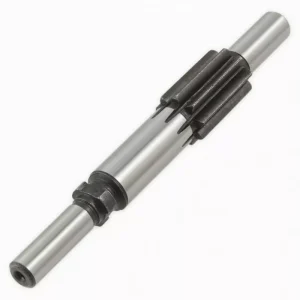
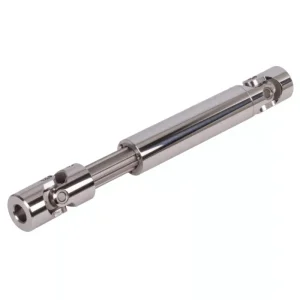
Ball Splined Shafts
Recirculating-ball linear bearing meets torque-transmitting spline — engineered for robotics, semiconductor handling and high-precision machine tool spindles.
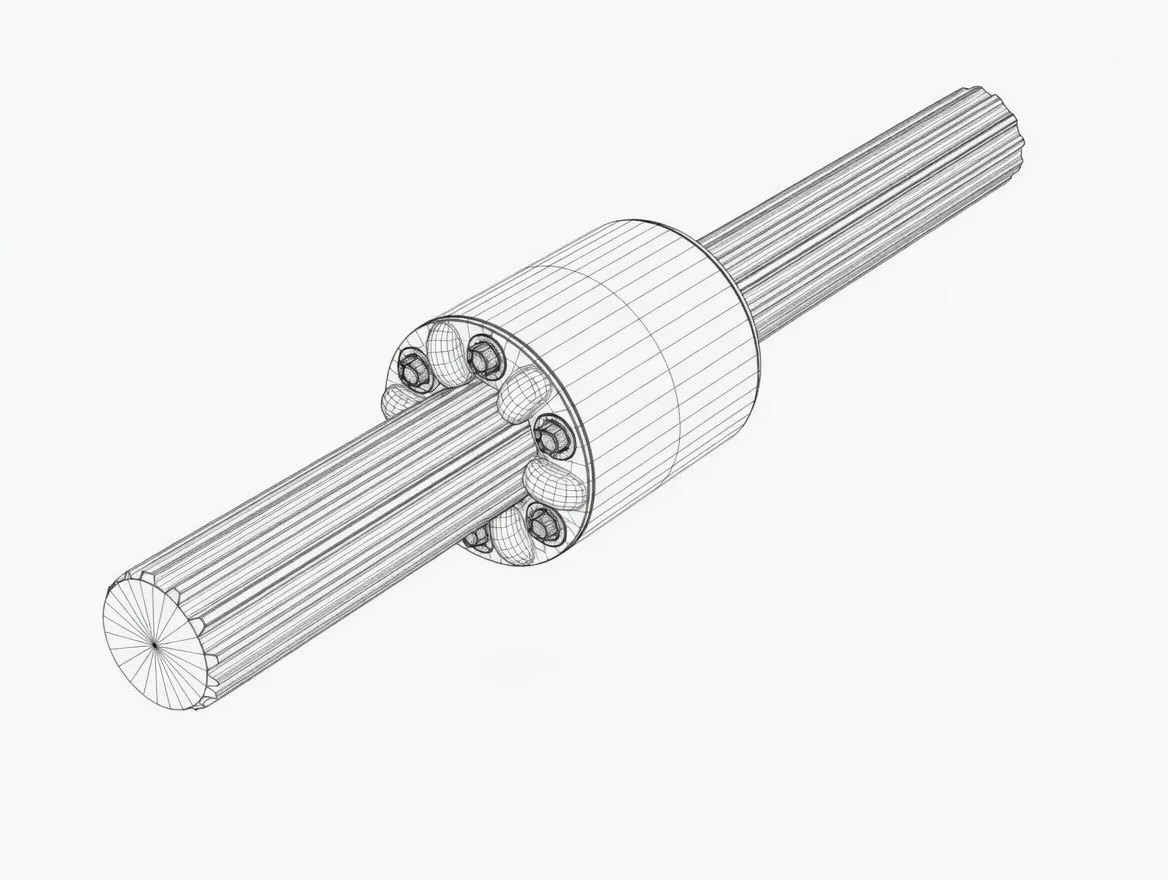
A conventional spline transmits torque, and a linear bearing permits axial travel — but combining the two in a single compact assembly is the unique province of the ball splined shaft. Hardened balls recirculate inside grooves machined along the shaft, simultaneously locking rotation and rolling along the axis with friction coefficients below 0.005.
Ever-power supplies ball splined shafts dimensionally and performance-equivalent to THK, NSK and Hiwin catalogue parts, plus fully custom designs for Australian robotics integrators, electronics assembly OEMs and CNC machine tool builders requiring zero-backlash linear-rotational motion.
 |
 |
How a Ball Spline Differs from a Conventional Spline
Three structural differences create one operational outcome — coupled torque and linear motion with rolling-element friction.
|
01 / GEOMETRY
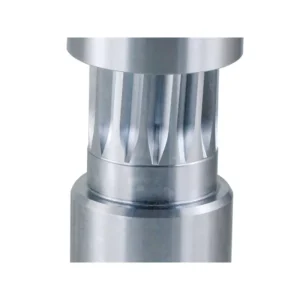
Gothic-Arch RacewaysEach shaft groove is a four-point-contact gothic arch ground to within 2 µm circularity, providing differential ball contact under load and zero clearance pre-load adjustment. |
02 / KINEMATICS
Recirculating Ball PathInside the spline nut, hardened steel balls travel down the load zone, return through internal recirculation tubes and re-enter the load zone — sustaining infinite stroke length at low rolling friction. |
03 / OUTCOME
Combined DOF MotionA single shaft transmits torque to the nut while permitting axial slide of either the shaft or the nut, eliminating the cost and packaging of separate spline-plus-linear-guide stack-ups. |
Technical Specifications & Standard Range
| Parameter | Range | Notes |
|---|---|---|
| Shaft Outer Diameter | Ø6 mm – Ø100 mm | Standard sizes 6, 8, 10, 13, 16, 20, 25, 30, 40, 50, 60, 80 |
| Shaft Length | 100 mm – 3000 mm | Single-piece up to 2000 mm; cut-to-length service |
| Number of Grooves | 3, 4 or 6 raceways | 6-groove for highest torque capacity per diameter |
| Material | SUJ2 / GCr15 bearing steel | Stainless SUS440C optional for cleanroom / corrosive use |
| Raceway Hardness | 58 – 62 HRC | Through-hardened, sub-zero stabilised against retained austenite |
| Rotational Backlash | 0 – 10 µm (preloaded) | P0, P1, P2 preload classes available |
| Surface Finish (raceway) | Ra ≤ 0.2 µm | CBN-ground with lapping finish |
| Travel Speed (max) | Up to 3 m/s | DN value calculated per ball circle diameter |
| Compatible With | THK LBS / LBF, NSK NS, Hiwin SO series | Drop-in dimensional equivalents on request |
Manufacturing Process & Precision Control
|
1
Bar Stock SelectionSUJ2 bearing steel cold-drawn to ±0.05 mm tolerance, ultrasonic inspected for inclusions before machining begins. |
2
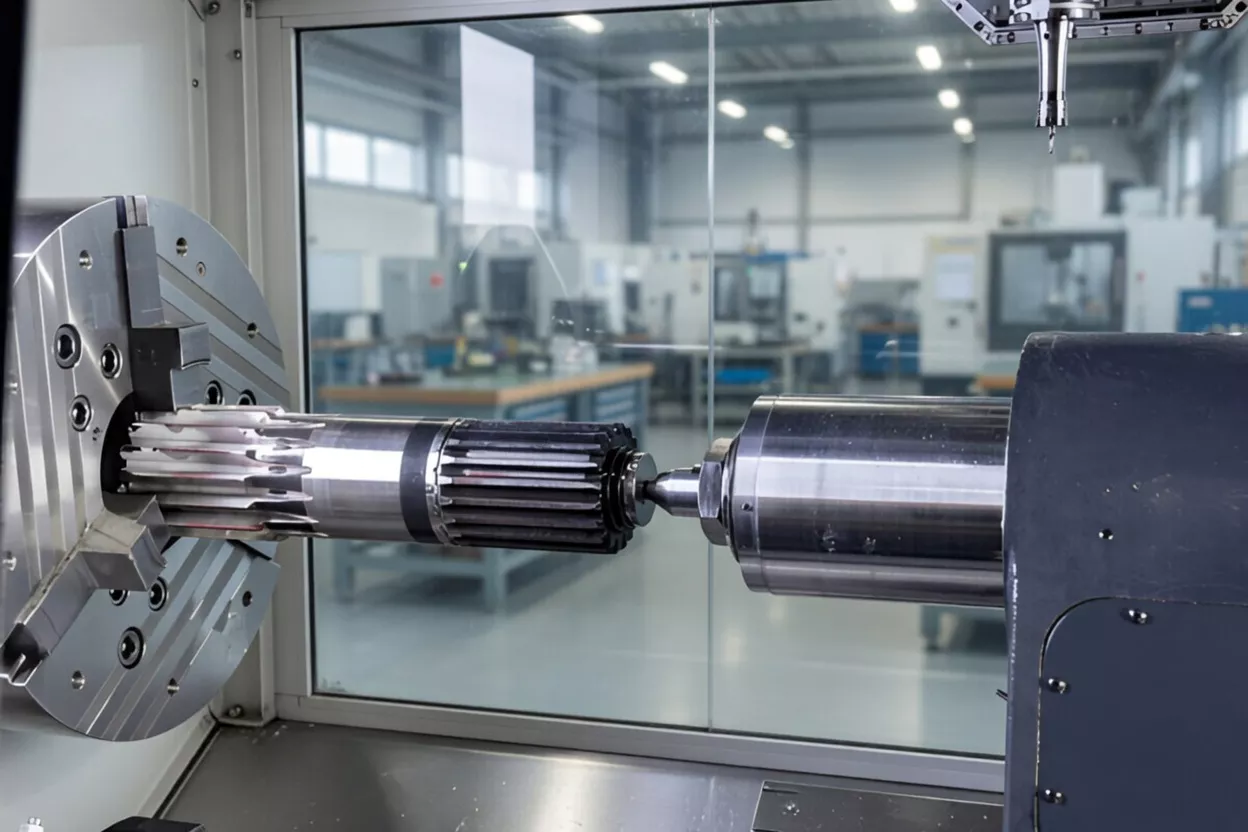
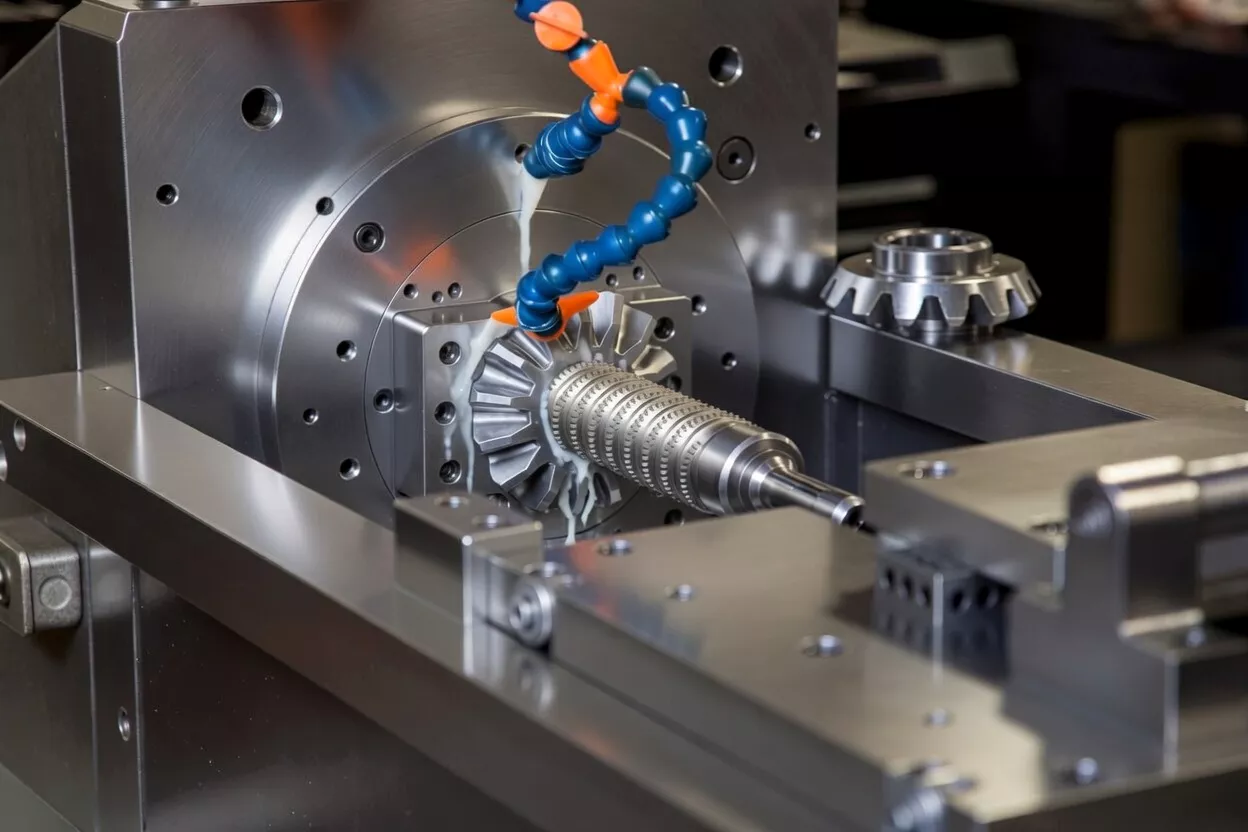
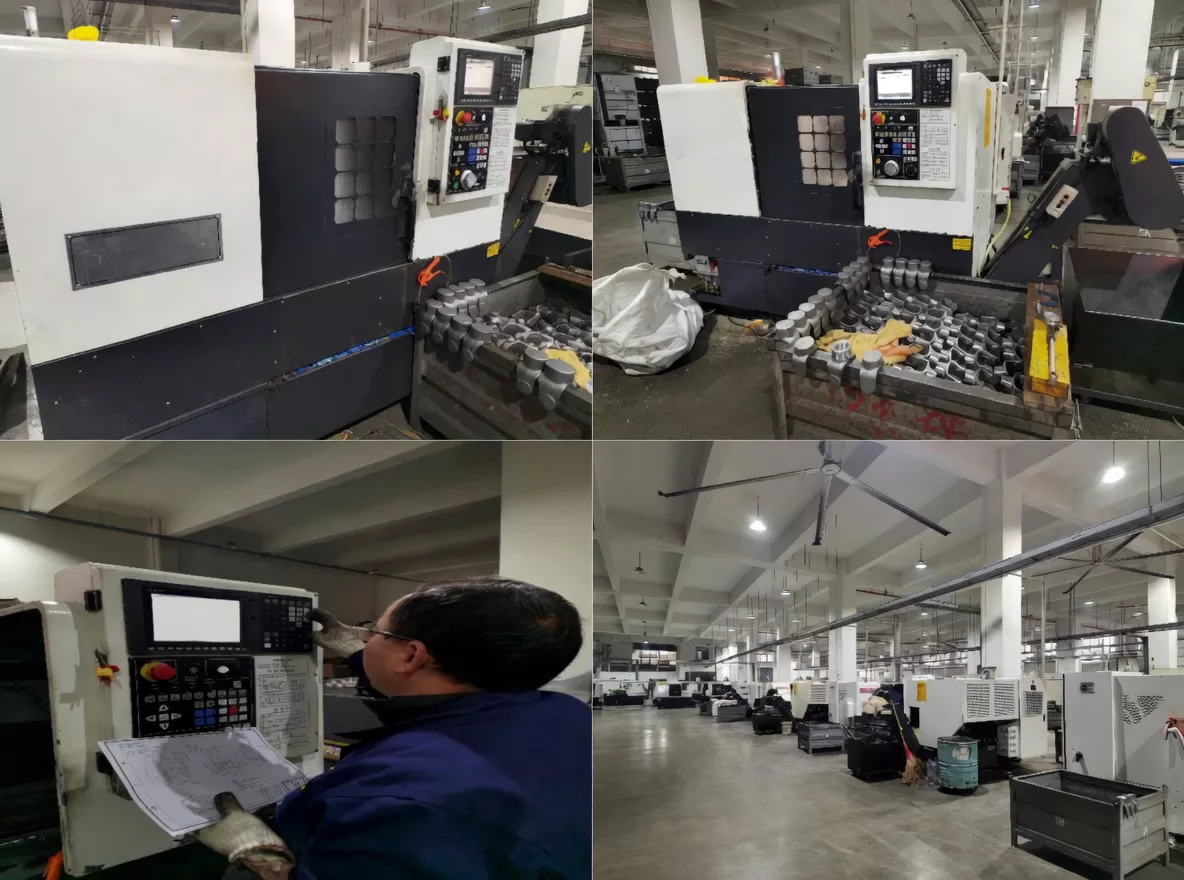
Soft Turning & Pre-GroovingCNC lathe rough turning, raceway pre-form milled with ±0.02 mm allowance for finish grinding. |
3
Through HardeningVacuum austenitising at 845 °C, oil quench, sub-zero treatment at –75 °C, double tempering for dimensional stability. |
4
CBN Raceway GrindingCBN form-grinding wheels finish all raceways simultaneously, holding gothic arch profile to ±2 µm. |
|
5
Cylindrical OD GrindingCentreless and between-centres grinding to h6 / h5 OD tolerance, straightness ≤ 0.01 mm per metre. |
6
Raceway LappingFinal lap reduces surface roughness to Ra ≤ 0.2 µm, eliminating micro-asperities for low-noise operation. |
7
Final QC & PairingUltrasonic clean, demagnetise to < 2 Gauss, CMM dimensional check, ball nut paired and preload-torque tested before VCI packaging. |
|
 |
 |
Application Domains
Industrial RoboticsSCARA Z-axis, six-axis robot wrist, palletising end-effectors — combined torque drive and vertical lift in one slim assembly. |
Semiconductor EquipmentWafer transfer arms, die-attach machines, photolithography stages — sub-micron repeatability in cleanroom-compatible stainless variants. |
⚙️
CNC Machine ToolsSpindle quill drives, ATC tool magazines, multi-axis indexing heads — long stroke with backlash-free torque transfer. |
Packaging & Pick-and-PlaceHigh-cycle FMCG packaging lines, pharmaceutical blister handling, electronic component placement — millions of cycles without service. |
Medical Device ManufacturingCT gantry indexing, surgical robot tool changers, lab automation liquid handlers — quiet, validated, traceable to lot. |
Logistics & AGV SystemsAutomated storage and retrieval, AGV lift columns, conveyor diverters — proven in 24/7 distribution-centre duty cycles. |
Why Choose Ever-power for Ball Splined Shafts
|
✓
Drop-In EquivalenceDimensionally and performance-equivalent replacements for THK LBS/LBF, NSK NS and Hiwin SO catalogue parts at typically 35–50% lower landed cost into Australian ports. |
✓
Three Preload ClassesP0 (light), P1 (medium) and P2 (heavy) preload selection, allowing engineers to optimise rigidity versus running torque for the actual application duty cycle. |
|
✓
22 Years of Spline SpecialisationOver 1.6 million spline assemblies shipped to 38 countries since 2003 — measurable history serving robotics integrators, machine tool builders and semiconductor equipment OEMs. |
✓
Sub-250 PPM Defect RateIATF 16949 quality system, EN 10204 3.1 mill test certificate, CMM dimensional report and preload torque chart supplied with every batch — full traceability to heat number and operator. |
|
✓
In-House Heat TreatmentVacuum hardening, sub-zero treatment and double-tempering all in-house — eliminating sub-supplier risk and shortening lead time by 8–12 days versus competitors who outsource. |
✓
DDP Australia LogisticsSea freight to Sydney, Melbourne, Brisbane and Fremantle with full ChAFTA Form for duty exemption, plus DDP option for receiving teams who prefer single-line landed pricing. |
 |
Australian Project Case Studies
|
Case 01 / Sydney
SCARA Robot Z-Axis for Electronics AssemblyA Sydney-based robotics integrator building printed-circuit-board assembly cells for Australian medical device makers needed Ø13 mm ball spline shafts with 320 mm stroke and zero rotational backlash. Their previous Japanese supplier had quoted 14-week lead time. Ever-power delivered 80 paired shaft-and-nut assemblies in 6 weeks, P1 preload class, paired and serial-tagged. After 18 months in continuous three-shift operation, all 80 cells reported zero spline-related downtime. Outcome: 8-week lead-time reduction, 41% cost saving versus original supplier.
|
Case 02 / Melbourne
CNC Tool Changer Spindle DriveA Melbourne machine-tool builder retrofitting their five-axis vertical machining centres specified Ø25 mm 6-groove ball splines for the automatic tool-change quill, requiring 40 Nm torque transmission while sliding 180 mm at 2.5 m/s. Ever-power supplied custom shaft length 750 mm with integral keyway at the drive end, hardened to 60 HRC, ground to JIS C5 accuracy. Acceptance testing showed 0.6 µm rotational backlash — well inside the 5 µm specification. Outcome: Specification exceeded, repeat order for 240 units across 2025–2026.
|
Frequently Asked Questions
Can your ball splines directly replace THK LBS series?Yes. Our shaft and nut envelope dimensions, mounting hole pattern, dynamic and static load ratings are matched to THK LBS catalogue values within ±5%. Provide the THK part number and we return a quotation against the equivalent Ever-power model. |
What torque can a Ø20 mm ball spline transmit?For a Ø20 mm 6-groove configuration, dynamic torque rating is approximately 95 N·m and static rating 220 N·m. Always derate by 0.6–0.8 for shock and reversing loads, and confirm against your service-factor calculation. |
Do you supply stainless steel ball splines for cleanroom use?Yes. SUS440C martensitic stainless raceways and AISI 440C balls are available for ISO Class 5 and Class 7 cleanroom environments, semiconductor lithography and pharmaceutical filling lines. Lead time is approximately 2 weeks longer than carbon-steel variants. |
What is the minimum order quantity?Standard catalogue sizes ship from 10 sets MOQ. Fully custom shafts (custom length, special end-form, non-standard groove count) typically start at 50 sets, though we run prototype quantities of 5–10 for development projects. |
How is rotational backlash measured and certified?Each preloaded assembly is fixtured on a calibration jig, the nut is rotated under a 0.1 N·m reversing torque, and angular displacement is measured with a 0.1 µrad encoder. The certificate of conformity records the actual reading per assembly serial number. |
What lubricant is recommended?For most applications a NLGI Grade 2 lithium-soap grease (Shell Alvania or Mobil Mobilux EP-2 equivalent) suits operating temperature –10 to +80 °C. Cleanroom variants ship pre-lubricated with vacuum-rated PFPE grease. Re-lubrication interval is typically 100 km of travel or 5 million revolutions. |